Showing posts with label putters. Show all posts

Monday, August 25, 2025

L.A.B. Golf, Golftec – and the World’s Worst Golf-tech Video

Recently I saw a post from the folks at Golftec that was intended to explain “lie angle balancing”, which is the latest hot new thing in putter design from the folks at L.A.B. Golf (home of the $600 – before options – putter.)

https://x.com/i/status/1956742227587224055

Here is a screenshot of the post in question. Last time I checked some 1,400-odd people had viewed it – and I hope that at least some of them thought to themselves, “What the absolute hell is this kid talking about?”

First let’s talk about the text of the post:

They wrote “Rather than balancing a putter around the shaft […] @labgolf putters balances their putter based on lie angle.”

Well, I’ve got news for you, folks – the lie angle is the angular relationship of the long axis of the shaft of the putter to the club head, therefore balancing the club around the shaft and balancing the club around the lie angle are the same thing – so right off the bat you can see that they are playing a little smoke-and-mirrors game with you.

Now let’s break down the problems with the video:

1) The term is “lie”–“angle” – two words, not “line-gle”, as the kid[1] in the clip pronounces it.

2) When he picks up a “standard putter”[2] he mentions “a potentially differing weight from the end of the club to the head of the toe”. What the hell does that mean? What I think it is that they are trying to get across here, however poorly expressed, is (the obvious[3] fact) that more of the mass of the club head lies to one side (the toe side) of the axis of the shaft than to the other (the heel side.) This imbalance causes the club to rotate about the shaft such that the toe of the club is lower than the shaft. This is called “toe hang”, and most putters have some amount of it.

3) He starts out with the “standard putter” balanced on a finger and held with the toe up, and says “when I let go of this club you’ll see it has the tendency to swing wide open[4].” Here he is using misdirection to emphasize this supposed undesirable aspect of the design of this non-LAB Golf putter. Pretty much putter ever made will swing down, dropping the toe, when held in this starting position. What is important is the angle of the face relative to horizontal when the putter is at rest.

4) He then takes what appears to be a left-handed[5] LAB Golf putter with a center shaft, balances it on a finger and (allegedly, because his other hand is not visible in the video) releases it, resulting in the face remaining vertical, saying, “so when I let go of this you’ll see how the face stays square.”

What he is calling “square” here is what anyone else would call 100% toe hang. No explanation is offered as to why this configuration is desirable, what benefits it has, or what stroke shape it is suited for (based on the conventional thinking that a large amount of toe hang is suited for a stroke with a large arc in the horizontal plane, 100% toe hang suits a massively arced stroke.)

And let’s talk about toe hang for a minute.

While one putter manufacturer touts a “toe-up” design that “significantly reduces the negative effects of torque, promoting a smoother and more consistent motion and allowing the putter head a greater opportunity to return to square at impact”, it is a generally accepted fact[6] that the greater the arc in your putting stroke (arc in the horizontal plane, to be clear…) the more toe hang your putter should have, ostensibly in order to facilitate the opening and closing of the face as the putter is swung back and then forward.

Since toe hang is caused by the center of mass being well out toward the toe, away from the shaft, in the horizontal plane as the putter is used, and the putter is being swung in the horizontal plane, what force is acting on the putter to make it rotate?

Gravity acts at 90º to the orientation of the moment arm between the location of the center of mass, and inertia – which can be treated as a force in a dynamic situation like this – would cause the toe to hang back as the putter is swung back, thus closing the face, and again, in the opposite direction as the putter is swung forward, opening the face. This is the opposite of the description I have read of the reasoning behind “big arc, more toe hang”, which is “toe hang facilitates the opening and closing of the putter face in the backstroke and follow-through”.

I have never agreed with the arcing-stroke school of putting because my engineer’s predilection for finding the simplest solution eschews the complexity of a motion that requires timing to ensure that the face of the putter is square to my intended line at impact. Is this “big arc, more toe hang” thing another one of those old wives’ tales of golf like “hit down to compress the ball” (don’t get me started on that one) which no one actually understands, and which doesn’t follow physical reality but which everyone nods their heads and agrees with because they don’t know any better?

I think so, yes.

5) Finally – to close out the video, the world’s worst spokesperson[7] says “LAB will fit you first to your “linegle” (sic) which will then determine how they get the shaft axis and the head balance within each other, hence the lack of twist.” This is gobbledygook that is worthy of a Republican legislator explaining why cutting your medical benefits and giving tax cuts to billionaires is really a good deal for YOU.

The bottom line is that this video does worse than promote misinformation; it gives no actual information at all, while purporting to present a wondrous new concept in the guise of an amazing revelation. It is a load of unrelated BUMF, nonsense statements strung together by someone who has no idea what he is talking about, and no concept of how to present information clearly.

Please – PLEASE – Golftec, do better. If you feel the need to promote putters that cost what we used to spend for a high-end driver, First – use a presenter who can at least sound like he knows what the hell is talking about; Second – illustrate and explain the physical differences between the putters that are being compared and present them each in the same way, visually; and finally – explain, or at least make an effort to explain, how the $600 putter achieves its radical physical characteristic, and why it will (supposedly) turn your basic 18-handicapper into Steve Stricker or Brad Faxon on the putting green.

And for goodness sake, send the kid in this video clip back to the stockroom to count sweaters.


[1] Don’t at me – at my age anyone under 40 is a kid…

[2] Do the folks at Edel Golf know that this kid used one of their putters like it was the “Before” photo in a weight-loss ad?

[3] Or it should be…

[4] The club face is not “wide open”, because “open” or “closed” is relative to swing path; it is, in this instance “toe down”.

[5] Important rule for experiments/demonstrations: Compare apples to apples. 

[6] I use the phrase “generally accepted fact” in the sense of “widely spread concept that may or may not actually reflect physical reality” – about which more later.

[7] Who is this kid, anyway? He doesn’t introduce himself, and offers no bona fides as to his qualifications (if any) to explain the complex dynamics of the putting stroke and how different configurations of putters affect it. He could be the stock-boy, or just some junior sweater-folder at the local golf superstore.

Wednesday, February 12, 2025

Adventures in putter-building: Frankenstein III

If you have been following my posts here for long enough you will have read (I hope…) several columns on the subject of putting, from why putting is hard, to how counterweighting your putter can help you make more putts, and how a graphite putter shaft can help (but not for the reasons generally touted by the folks who sell them.)

Like most golfers with something of an equipment addiction I own several putters, and consistent with my education and experience as a mechanical design engineer, I like to tinker with them. The five putters which I actually play (I have two or three more which are essentially antiques, of value only as curiosities) have all been bent more upright (within USGA limits, of course), tweaked as to loft (I prefer minimal to slightly negative loft – here’s why) and counterweighted for better balance and therefore better speed control.

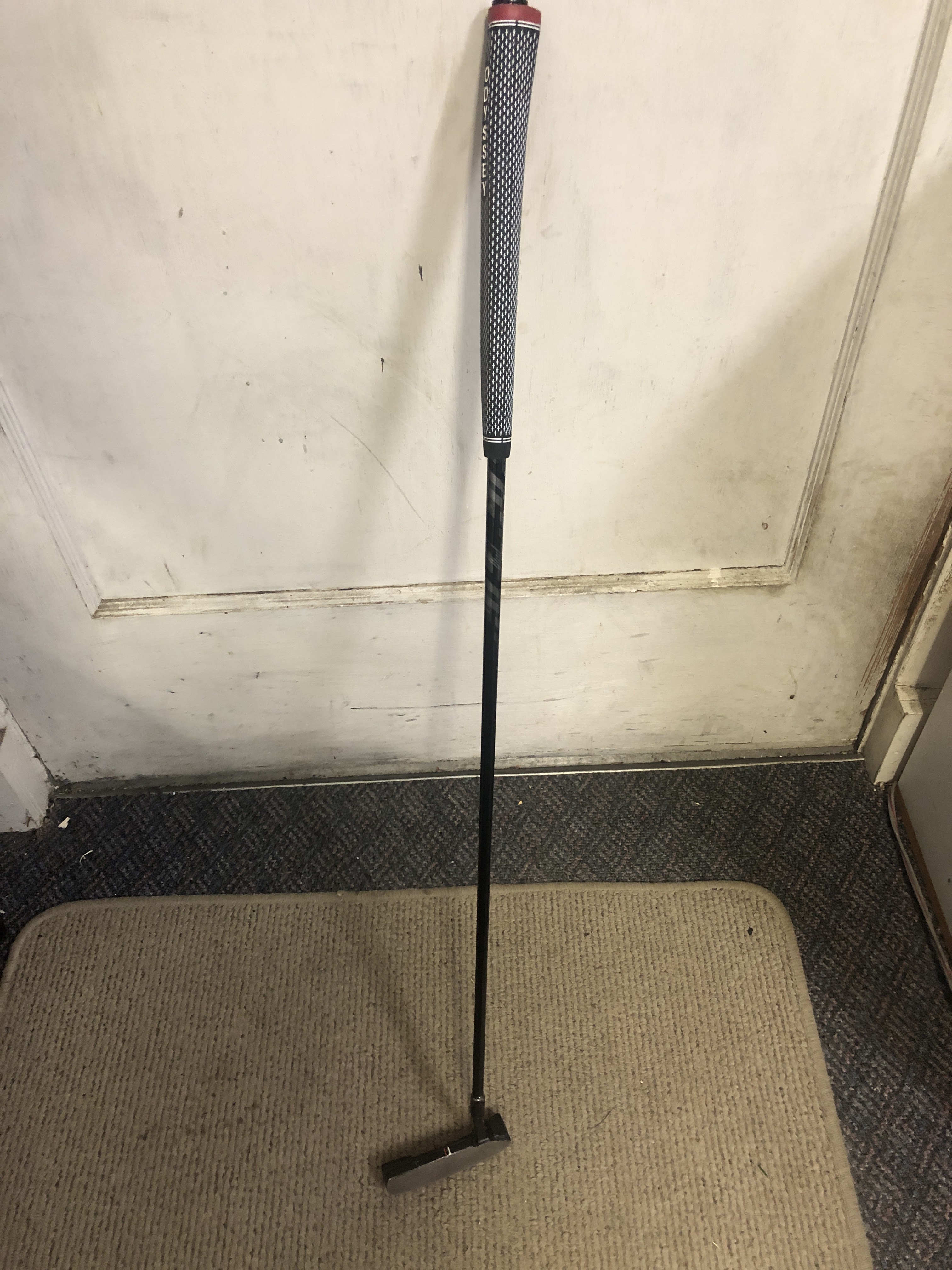
The most recent addition to my stable is a self-built putter based on a Ben Hogan Golf BHB-01 plumber’s neck blade putter head. I installed the shaft that came with my Odyssey Golf Tank Cruiser 1 putter—which was re-shafted, for a while, with an early version of the BGT Stability Shaft (about which more here)—and my preferred Odyssey White Hot pistol-style grip. I drilled out the threaded fitting in the butt end of the Odyssey shaft to allow me more options for counterweighting than just the 15- and 30-gram counterweights that came in the Odyssey’s weight kit, and opened up a hole in the end of the Odyssey grip to allow the fitting of one of the range of Super Stroke Counter Core counterweights (25-gram, 50-gram, or 75-gram). I also filed an alignment mark on the top line and filled it with white paint.

The Odyssey Tank Cruiser, meanwhile, had the BGT Stability Shaft replaced with a $15 standard steel shaft. To reduce toe hang I removed the weight from the toe port in the sole, replacing it with cork, and installed a 20-gram weight in the heel port. I installed an Odyssey White Hot pistol-style grip, and opened up the hole in the butt end to take a Super Stroke counterweight. 

While the Ben Hogan-based putter is a “bitsa” build—put together from “bits of this and bits of that”—the real Frankenstein’s monster in my putter stable is the continuously evolving build that started out as a $17 new-old-stock Tight Lies blade putter that I purchased online. This putter, in one of its several modified iterations, was the one that I had in my bag in May 2019 when I played Pebble Beach during the USGA’s media day for the U.S. Open. It was a day that had its ups and downs, but one in which I had a great round on the greens, with eleven two-putt greens, and four one-putts.

Aside from a bit of tweaking for lie and loft, the first big change for this putter was the installation of the stock Odyssey shaft (with the 30-gram counterweight) when my Odyssey Tank Cruiser was getting fitted with the BGT Stability Shaft. From there I went to a more radical change, cutting down and transplanting a graphite shaft into the Tight Lies head—the shaft, an Aldila 350, came from a donor club: the driver that was part of my first set of garage-sale used clubs. As I explain in my column about the benefits of a graphite putter shaft, removing mass from the middle of the length of the club increases stability and improves speed control; “Frankenstein”, as I have dubbed the Tight Lies putter, was my first test bed for the benefits of this concept.

This putter went through several subsequent iterations that involved increasing amounts of lead tape on the head, with corresponding increases in counterweighting, all intended to bring it up to the same overall mass and swing weight as the modified Odyssey Tank. Damage to the shaft that occurred during a bout of loft/lie adjustment spelled the end of that particular experiment, so I decided to take it a step further.

Enter the latest iteration of the Tight Lies putter, dubbed Frankenstein III. It now incorporates a brand new graphite shaft, this time a Mitsubishi Rayon KURO KAGE Black Parallel iron shaft, stiff flex, .370 tip, cut down to yield my preferred 35-inch total length. To make the installation of a butt-end counterweight cleaner I sacrificed a Super Stroke grip for the threaded fitting which takes the Counter Core family of weights. Previous grip modifications to accommodate a grip weight involved drilling a hole in the butt end of the grip to a size that allowed the threads on the counterweight to bite into the rubber of the grip; gluing in the plastic threaded fitting from a Super Stroke grip makes the installation a bit tidier.

Frankenstein III, in all its glory

Shiny-new stiff-flex graphite shaft

Logo partly covered by the grip
shows that the shaft has been cut down

To complete the build I installed a 75-gram Super Stroke Counter Core weight. With a head weight of 391.8 grams, a shaft weight of 56.2 grams (less than half the weight, and at $29.95 less than 1/6 the cost, of the BGT Stability shaft), a grip weight of 67.2 grams, and an actual 74.0 grams of counterweight (plus a smidge for grip tape and adhesive) yields an all-up weight of 592.2 grams, or about 1 lb 5 oz. Thanks to the lack of the added lead tape that had previously been wrapped around the shaft of the 75-gram counterweight, this is about 20 grams shy of the weight of the previous iteration, and that of the modified Odyssey Tank. Loft remains at -1º, and the lie angle is 1º shy of the USGA limit, at 79º.


The 75-gram counterweight installed
in my preferred Odyssey putter grip

The swing weight of “Frankenstein III” is E5, making it a touch more head-heavy than its previous iteration at E4, and considerably more so than the modified Odyssey Tank, at D4, and the Hogan BHB-01 build, at D0. The new build feels well-balanced, and I have found it to be consistent and controllable when practicing on my office carpet (which stimps at about 13–14); I can’t wait for our current bout of rainy weather to end so that I can go try it out on real greens.

Playing around with putters is considerably easier and less critical than building or rebuilding full-swing clubs; because of the lower forces experienced by a putter during use you don’t have to worry so much about whether you got the crucial head-to-shaft bond exactly right. Even if you don’t go so far as to re-shaft a putter, a little bit of tinkering with counterweights in the grip and lead tape on the head may surprise you with the benefits that are derived from improving the balance of your “flat stick”.

Wednesday, May 26, 2021

Graphite putter shafts, Part I: Why the big manufacturers with skin in the game are doing it wrong

I spend more time practicing putting (on the carpet in my office, which stimps at about 13, I figure) than any other part of my game, and I read with interest all the articles about putter design and the putting stroke that I come across. I also follow new developments in putter design, many of which turn out to be pointless, ridiculous, overhyped, or just plain wrong (see my review of the Stability Shaft by Breakthrough Golf Technology, on which more later in this column.)

In pursuit of better putting I have experimented with counterweighting by adding grip weights to my putters, for which there is a factual physical basis, unlike many of the spurious putting “innovations” which are touted in Golf Channel infomercials and even by big-name manufacturersExtrapolating the concept of increasing stability by redistributing mass from the shaft to the ends of the club, the next thing that I wanted to do was to replace the steel shaft in my putter with a graphite shaft.

Changing from a steel putter shaft to a graphite shaft can save as much as 100 grams, freeing up that mass to be moved to the head and the grip end of the club while keeping the same total weight; a change which, as I explain in the counter-weighting article, increases the club’s stability in the long axis, which benefits speed control.

But before I talk about my putter-shaft experiment, let’s look at the current state of the art in graphite composite and multi-material putter shafts.

Who is making graphite putter shafts, and why?

There are three manufacturers that I know of that are currently marketing graphite-composite shafts, or shafts incorporating graphite-composite, for putters: Odyssey, with their Stroke Lab shafts (though not available as a retrofit item); Breakthrough Golf Technology (BGT) with their so-called Stability Shaft (retail cost $129.99 to $299.99); and LA Golf, which markets a line of graphite shafts up and down the bag, including three for putters (retail cost $419.00).

Of those three companies only Odyssey specifically cites the redistribution of mass as a benefit of the use of their graphite-composite shaft, and their Stroke Lab line of putters include the use of additional weights in the head and the grip of the club to redistribute the mass saved in the shaft. Both Breakthrough Golf Technology and LA Golf, however, cite the so-called “low-torque” characteristics of their shafts in preventing “head wobble” as the prime benefit.

These three manufacturers differ not only in the claims they make for the benefits of their composite shafts, but in the details of their construction. The Odyssey Stroke Lab shaft and the BGT Stability Shaft are multi-material units which combine a graphite-composite tube for the upper portion of the shaft with a length of conventional steel shafting for the lower portion which mates with the putter head. The Stroke Lab shaft uses unspecified means to bond the steel and graphite sections of their shaft together; the BGT design uses both an aluminum stiffener and a separate aluminum connector between the two sections.

The LA Golf putter shafts, on the other hand, are 100% graphite composite material, but like BGT, their advertising cites the “stiff, low torque” characteristics of their shafts in preventing head wobble or deflection that is “caused by traditional shafts” as the advantage of their product.

So let’s break it down:

Manufacturer            Construction Type                    Claimed Benefit
Odyssey                   Graphite upper/steel lower        Improved mass dist'n

Breakthrough Golf     Graphite upper/steel lower        Improved head
Technology                w/aluminum stiffeners and       stability
                                connector midshaft

LA Golf                     100% Graphite composite         Improved head
                                                                              stability

Both BGT and LA Golf claim that conventional steel putter shafts are weak—weak enough to twist in response to the forces exerted on them by the inertial forces resulting from the movement of the club acting on the mass of the club head.

The following quote is from the LA Golf website:

“Recent data shows that outside 12 feet, when a player begins forward motion the head wiggles slightly and that instability can change your putt line even if you read the line correctly and put the perfect stroke on it.
The head also wiggles when you strike the putt even fractionally off center (which everyone does) causing you to lose distance on the roll.”

It is, of course, utter nonsense to attribute the motions described in that quote to flex in the shaft; to do so is to reveal a complete lack of understanding of the magnitudes of the forces involved, and the ability of the structures being discussed to handle the forces to which they are subjected.

Of course, the people who want you to shell out anywhere from $130 to over $400 for a new putter shaft are counting on the average golfer taking their quasi-scientific marketing jargon at face value—but if you keep reading you will learn how they are leading you astray.

What do they mean when they say “torque”?

What the ad copy for golf club shafts refers to, incorrectly, as “torque”, is the torsional stiffness of the golf shaft. It’s measured by clamping the butt end end of the shaft in a fixed position and applying one foot-pound of torque—that is, a force of one pound acting at a distance of one foot from the center of the shaft—at a point further down the shaft and measuring how much the shaft twists. (The results obtained from this test can be greatly affected by the testing method—especially by the length of shaft between the clamping point and the point at which the force is applied—so comparisons between the data given by different manufacturers are not necessarily valid.)

This “torque” number can range from three or four degrees for a steel shaft to upwards of eight degrees for the more flexible graphite shafts—but these numbers are only really relevant for full-swing clubs: wedges, irons, hybrids, and woods; clubs in which the club face contacts the ball at speeds of up to 125 miles per hour (Note: PGA Tour pros average about 110 mph of club head speed with driver, and some go much higher.) Those high club head speeds produce very high resultant forces on the club head, and therefore, significant torsional forces in the club shaft.

For putters the force acting on the shaft, even as a result of impact with the ball, is orders of magnitude lower than for full-swing clubs, and the torque input to the shaft resulting from inertial forces acting on the club head before contact with the ball are so far below the threshold which would result in deformation of the shaft that they can be ignored.

The bottom line…

The claims that are being made by Breakthrough Golf Technology and LA Golf—that larger, heavier modern putter heads “overpower” a conventional steel shaft, and thus require their expensive, over-engineered offerings, which are actually no stiffer in torsion than a generic $9 steel putter shaft—are complete nonsense.

The all-graphite composite shafts from LA Golf are the right idea, but they appear to be doing the right thing for the wrong reason—and they cost waaay too much.

The sophisticated multi-component shafts such as the BGT unit and the Odyssey Stroke lab shaft introduce complexity where simplicity will do; the complexity adds no value, and actually compromises the potential effectiveness of lighter-weight graphite composite construction by the use of a steel lower shaft. The BGT Stability Shaft is the most egregious offender of the two, due to their use of two aluminum components mid-shaft, at the junction of the graphite and steel portions, which returns mass to the middle of the club.

In Part II of my look at graphite-composite putter shafts I will walk you through my home-workshop experiments, in which I modified my bargain-bin Tight Lies Anser-style putter as an experimental test bed.

Stay tuned.

Monday, June 25, 2018

The Stability Shaft – how good for your game is a high-tech, multi-material putter shaft?

As I mentioned in my previous post – Putting is hard – but you already knew that, right? –  I bring years of experience as a mechanical engineer, and a naturally skeptical nature, to the task of reviewing and evaluating golf equipment. I am very critical of the performance claims that equipment manufacturers make for their latest design innovation, and I subject them to close scrutiny. Putters seem to be the worst offenders when it come to gibberish tech-speak, but many golfers still seem to eat it up.
Because of the difficulty of putting and the irrecoverable nature of poor performance on the greens, club manufacturers seem to be constantly introducing some new high-tech innovation that will help golfers improve their putting. Sometimes it’s a training aid, sometimes it’s a design tweak to the putter itself, but it seems as though there is always something new coming down the pike when it comes to putters.
The latest high-tech innovation to come to putters is the Stability Shaft, from Breakthrough Golf Technology, with the involvement of well-known golf club pioneer Barney Adams, the inventor of metal fairway “woods” – the original Tight Lies clubs. While I will admit that this is a fairly new approach – little has been done with putter shafts over the years – the needle of my skepticism meter started twitching as soon as I read the ad copy on their website.
Wait, it does what?
The four-part, multi-material Stability Shaft is made up of a carbon-fiber composite tube, which forms the grip end and most of the length of the shaft; an aluminum insert placed inside the carbon-fiber tube at its lower end to “reinforce flexural rigidity”; and a 7075 aluminum alloy connector which adapts the upper end of the shaft to the conventional stainless steel tube which mates with the putter head.
The main structure of the shaft is described as “Eight layers of high-modulus carbon fiber specifically layered, wrapped and widened, with a no-taper design to greatly reduce torque.” This statement makes little or no sense in terms of mechanical attributes of the structure, or the functional requirements of this portion of the putter shaft. The little loading, either in bending or in torque, that a putter shaft experiences is concentrated at the other end of the shaft, where it is joined to the putter head.
Regarding the aluminum insert, their ad copy says, “Through finite element analysis a light-weight, 22-gram aluminum insert was developed and precisely located to reinforce flexural rigidity.” (“Flexural rigidity” is an oxymoron, by the way.) If the high-tech “high-modulus carbon-fiber” main body of the shaft is so precisely designed to resist deformation due to torque loading (which is what they really mean by “…a no-taper design to greatly reduce torque”), why are they adding half the weight of a golf ball near the middle of the shaft to increase rigidity?
Another claim for the Stability Shaft is that it “…delivers the face squarer at impact for improved accuracy and solid feel…”. The forces acting on a putter are low at impact, even lower during the swing. The rigidity and stability of a putter shaft is concerned with forces that are substantially less than those encountered in a full swing club, so what forces do the designers of this shaft feel are acting to deform the shaft of a putter during the swing? The only rotation experienced by the putter face will be the result of rotation of the entire club, caused by variability in the player’s grip, and arm and hand movement.
Fancy data says what?
The website for Breakthrough Golf Technology offers a pair of graphs which are said to show the velocity of the heel and toe of a putter with a standard steel shaft and with the Stability Shaft. Represented as showing toe and heel velocity at a data rate of 2,500 frames per second, based on the “Frame Number” scale along the bottom of the graph, they depict a little over 1/10th of a second in the motion of the putter, about 3/4ths of which is before impact. The lines for toe and heel are fairly uniform preceding impact (though apparently offset, which must be for clarity, to differentiate between the two, because unless the putter is moving through an arc, they should be moving at the same rate), but after impact the graph for a “Standard Steel Shaft” shows significant deviation of the two lines from each other, represented as a difference in velocity between the heel and toe. The graph for the putter with the Stability Shaft shows much more uniform velocities for the heel and toe, ramping up again evenly after the expected drop at impact.
Putter with a standard steel shaft

Putter with the Stability Shaft


Leaving aside the other questions which these graphs raise (the unlabeled velocity scale, for example, and the lack of information about how the data was gathered), what value is there in uniform velocity between heel and toe, if indeed that is what is actually being depicted, AFTER impact? If the ball is no longer in contact with the club face, no movement that the club face undergoes has any effect on the motion of the ball.

The amount of time represented in the graphs after impact, again, based on the frame number scale along the bottom, is approximately 4/100ths of a second. The changes in velocity depicted on the graph – which are not quantified – occur in a very short timeframe, and there is no information offered as to the magnitude of the displacement which these “velocity changes” represent. If the concern is the squareness of the club face, it is obvious that the relative displacement, therefore the relative positions, of the heel and toe of the club would be of concern.

You keep using that word. I do not think it means what you think it means

The more I looked at and thought about the data that these graphs are supposed to represent, the more I came to be convinced that these graphs must depict vibration in the club head measured at the heel and toe ends, not the velocity of the heel and toe of the club head.
The graph for the steel shaft before impact shows tight, consistent data for the heel and toe, with after-impact data that is consistent with undamped vibration in a rigid material, such as a high-strength stainless steel shaft. The graph for the Stability Shaft depicts slightly less-regular behavior before impact compared to the steel shaft data, and a well-damped behavior afterwards. The latter is consistent with a system which contains a vibration-damping component such as a wound carbon-fiber tube.

How I evaluated the Stability Shaft
My experience with the Stability Shaft is based on the conversion of my Odyssey Tank Cruiser blade putter. Before sending it off to the people at Breakthrough Golf Technology, I swapped out the counterweighted original shaft (because I would not be getting it back) for the plain steel shaft from (ironically…) an old Tight Lies stainless steel blade putter. The Tight Lies received the counter-weighted shaft from the Odyssey.
Needless to say, when I got the Odyssey back with the Stability Shaft installed, it felt much different. Not bad, necessarily, but different. The balance was off, for instance, without the counterweight, and I noticed that the head was a bit wobbly in the take-away as a result. In order to make this as complete a test I could, after a few weeks of using the club as-is I decided to remedy that situation.
A trip to a local golf shop netted me a 50-gram counterweight kit for Super Stroke putter grips. Even though I don’t use that type of grip, I was able to install it securely in the grip end of the re-shafted Odyssey – and it transformed the putter’s performance.
Counter-weighting increases the inertial moment of the putter (its resistance to rotation) along the long axis from grip to club head, stabilizing the club during the takeaway and the down swing (such as it is with a putter.) I had noticed the difference with the Odyssey when I first got it, installing the grip counterweight after having used the club for over a year with no weight in the grip, and I noticed it in the Odyssey Mk II (as I am referring to it) with the Stability Shaft. I now own two counter-weighted putters – the Odyssey Tank Cruiser with the Stability Shaft, and the old Tight Lies which inherited the Odyssey’s original shaft – and frankly, it has become a toss-up which one I put into the bag when I play.

In conclusion
Unlike the folks at BGT, I don’t have high-speed video, or sophisticated data-gathering equipment of any kind, at my disposal with which to evaluate clubs – only my eyes, ears, and hands. What they told me over a few weeks of using my re-shafted Odyssey putter is that the Stability Shaft is not a miracle solution to anyone’s putting woes, whatever they may be.
My knowledge and engineering experience told me that the claims that are made in their advertising copy are suspect, and the time I spent with the re-shafted putter showed that, at best, after becoming accustomed to the altered swing weight of the putter, I was no worse off than I had been before. Further modifying the club with the grip end counter-weight improved the swing stability of the “Odyssey Mk II” – which reinforces what I had previously learned about counter-weighting, but did not substantiate any of BGT’s claims.
So – if you have the spare cash to drop $200 on a putter shaft, and really want to explore the option, you may find that the Stability Shaft feels right in your hands, and with your swing; but if a putter with the Stability Shaft works better for you, it’s more about balance and feel that works with your particular stroke than it is about any of the performance claims that Barney Adams and the people at Breakthrough Golf Technology are making.

Saturday, June 23, 2018

Putting is hard – but you already knew that, right?

I am a mechanical engineer with 37 years of experience in mechanical design, analysis, and test. I am also a born skeptic – and I bring both my skepticism and my engineering experience to bear when I review and evaluate golf equipment.
One of the prime targets of my skepticism is putters. I believe that there is more hype, misinformation, wishful thinking, and utter nonsense attendant upon the design and use of the last club in the bag than the other 13 clubs put together. You know why? Because putting is hard, and as it is the end of the process of getting the ball from the tee to the hole, errors made with the putter are unrecoverable.
Think about it. Hit an errant drive, and as long as you can find the ball, and play it, you have a chance of recovering with a good second shot. Dump your approach shot into a greenside bunker, and if you are handy with a wedge you still have a chance at getting up and down for par. But blow a putt, or two, and your score on the hole is heading into “plus” numbers – no quarter asked, none given. There is no recovery from bad putting – it’s do-or-die, make it or go home.
“The devoted golfer is an anguished soul who has learned a lot about putting, just as an avalanche victim has learned a lot about snow.”
   – Dan Jenkins
And putting demands a level of precision that is not required from tee-to-green shots. Sure, you want good placement in the fairway off the tee, and you’d like to be able to do better than just get it somewhere on the green with your approach – but your target with the putter is 4-1/4 inches in diameter – just over 2-1/2 times the size of the ball. Which means that the level of accuracy that is required when putting is orders of magnitude greater than with any other shot on the course.
Consider this: When facing a 10-foot putt on a dead flat, level surface, a deviation of only 1° in the face angle of the putter at impact introduces an aiming error equal to half the diameter of the hole – the difference, all other things being equal, between missing and making the putt. 
A successful putt requires the golfer to match ball speed with the proper line, and then deliver the ball properly on that line. Given the “speed” of the putting surface – that is, the level of resistance it offers the rolling golf ball – there is a minimum ball speed that will get the ball to the hole, and a range beyond the minimum within which the ball will go into the hole and not bounce or lip out.
To further complicate matters, this speed varies depending upon how close to center the ball is when it gets to the hole. A ball traveling at a speed which allows it to fall into the hole on a dead-center hit may lip out if it arrives at the hole off-center. The more off-center, the slower the ball must be moving when it encounters the edge of the hole.
And then there’s slope. Greens are rarely flat, so the ball must be started on a tangential vector which will allow it to follow the curving path that ends at the hole. The faster the ball is going, the less it responds to the curvature of the putting surface, so when determining the aiming line for a putt, the golfer must decide what combination of ball speed and path will deliver the ball to the hole within the range of speed which will allow it to fall into the hole.
Add to the equation the fact that to get the ball into the hole you have to roll it across a living, and highly variable, surface. It’s not flat, and the amount of resistance which it offers the ball can differ from green to green, even from yard to yard on the green, and throughout the day as weather conditions change.
Suffice it to say that the difficulty, variability, and unforgiving nature of putting drives golfers a little crazy. The average golfer owns from one to five putters (and not a few own ten or more), and there are probably more different kinds of gadgets designed to improve your putting stroke and your ability to read line and speed than there are for any other part of the game.
Manufacturers sense the desperation that golfers feel when it comes to putting, and regularly introduce new innovations that are ballyhooed as game-changers, accompanied by testimonials, plaudits, and masses of quasi-technical lingo that is often just marketing bumf. Different face materials are touted to “improve feel” or “increase responsiveness”. Tweaks to the placement of the alignment mark promise to help you zero in on your preferred line better, or grooves on the face are claimed to put correcting spin on the ball and actually curve it back toward the hole.
The bottom line on putters, as far as I am concerned, is that it all comes down to what feels good to you. Try before you buy. Try every putter in the store, then go to another store and try some more. Get fitted by one or another of the high-end custom putter makers if that suits you, but in the end, figure out what putter feels best in your hand, and works best with your natural stoke. That’s the putter that will work best for you.
And then all you have to do is master the art – and it is an art – of reading line and speed, and you will start making more putts. Simple, right?