Showing posts with label Ben Hogan. Show all posts

Wednesday, June 25, 2025

Book Review: “The Golf 100”, by Michael Arkrush ⭐️⭐️⭐️⭐️☆

Michael Arkrush is a sportswriter with more than a dozen books to his credit, but one who was unfamiliar to me before this title came to my attention. His previous books have focused largely on either boxing, basketball, or coaching. He does have four previous books concerning golf, but I have only read one: Getting Up and Down: My 60 Years in Golf – an autobiography of Ken Venturi that he cowrote with Venturi, and it wasn’t until I looked up his back list that I realized that he was associated with that title.

From the first page of The Golf 100 I realized that I had been missing out. Arkrush is a writer with a casual but effective voice who writes with a touch of bantering humor.


The Golf 100, by Michael Arkrush, is full to the brim with informative
biographical sketches about one hundred of the top golfers of all time.

He set himself quite a job – as the author himself acknowledges, ranking the Top 100 golfers of all time is not so much a tough task as an impossible one, and the content of this book is sure to elicit plenty of questions and disagreement over drinks at the 19th Hole of any golf course frequented by literarily or historically inclined golfers (1).

There’s no arguing, in my mind, with the Top 10 (though if he hadn’t ranked Ben Hogan within the Top 5 I might have found myself firing off a strongly worded letter…), or even the Top 20. The further down the list one goes the more room there is for argument, but in reality, the further down the list you go the less it matters – if you are prepared to argue about the relative placement of Leo Diegel and Harold Hilton in the list of the Top 100 Golfers of All Time you should probably look for a different hobby.

Many of the names found in the bottom fifty places of the list may be unfamiliar to all but very dedicated students of the game’s history – some of the names were vaguely known to me but I couldn’t have told you much about their accomplishments before reading this book. And therein lies the raison d’être of Mr Arkrush’s efforts – the value in this books lies less in the actual ranking of golfers than it does in identifying the lesser-known personalities on the list and giving a quick sketch of their careers and accomplishments.

Quick sketch is the operative word here. The author gets through the list of 100 names in a little over 350 pages. Most of the listings range in length from three to a little over four pages; Tiger Woods rates six and a bit, and Jack Nicklaus, eight pages. Frankly there’s sometimes not a lot to say about the golfers in the lower ranks, but there is value in what the author does include, for example: John McDermott, #100, the 1911 U.S. Open winner, suffered a breakdown a few years later and spent most of his life in mental institutions; or Larry Nelson, #89, a self-taught golfer who hadn’t even picked up a club before he turned 21, taking up the game after returning from a tour as an infantry squad leader in Viet Nam. Nelson won the 1983 U.S. Open at Oakmont, closing with two under-par rounds and clinching the win over Tom Watson with a 60-foot putt that must have looked a lot like the putt that recently clinched the 2025 U.S. Open for J.J. Spaun.

Argue as you might about their places on the list, every golfer in this book deserves mention, and each has an interesting story attached to their name.

I could quibble over the structure of many of the short biographical sketches that make up this book; Arkrush sometimes shows a disorienting tendency to work through events that occurred later in the subject’s career, then jump back to formative events from their early life. He also sometimes skims over details that beg for another sentence or two of explanation and then leaves the reader hanging – for example, he mentions that Bay Area golf star Juli Inkster borrowed clubs from Patti Sheehan to play, and win, the 1981 U.S. Women’s Amateur (her second of three in a row), but doesn’t mention why. A bit of research (maybe a phone call?) and a couple of lines added to that section could have added a neat little anecdote to the story.

So, this book isn’t perfect, but it is really, really good, standing up on its own and also as a gateway to further reading for the history-minded golfer whose interest is piqued by the short sketches it presents; the three-page bibliography is a good start on further exploration for the curious reader. Father’s Day may have come and gone already this year, but for the golfer with a late-in-the-year birthday, or as a Christmas gift, this book is a serious contender for the gift list.


1) Given the opportunity, I would like to have a talk with Arkrush about the non-inclusion of Bay Area pro George Archer, the 1969 Masters winner who struggled with a learning impairment that left him unable to read any but the simplest sentences; he could only write his own name.

Wednesday, February 12, 2025

Adventures in putter-building: Frankenstein III

If you have been following my posts here for long enough you will have read (I hope…) several columns on the subject of putting, from why putting is hard, to how counterweighting your putter can help you make more putts, and how a graphite putter shaft can help (but not for the reasons generally touted by the folks who sell them.)

Like most golfers with something of an equipment addiction I own several putters, and consistent with my education and experience as a mechanical design engineer, I like to tinker with them. The five putters which I actually play (I have two or three more which are essentially antiques, of value only as curiosities) have all been bent more upright (within USGA limits, of course), tweaked as to loft (I prefer minimal to slightly negative loft – here’s why) and counterweighted for better balance and therefore better speed control.

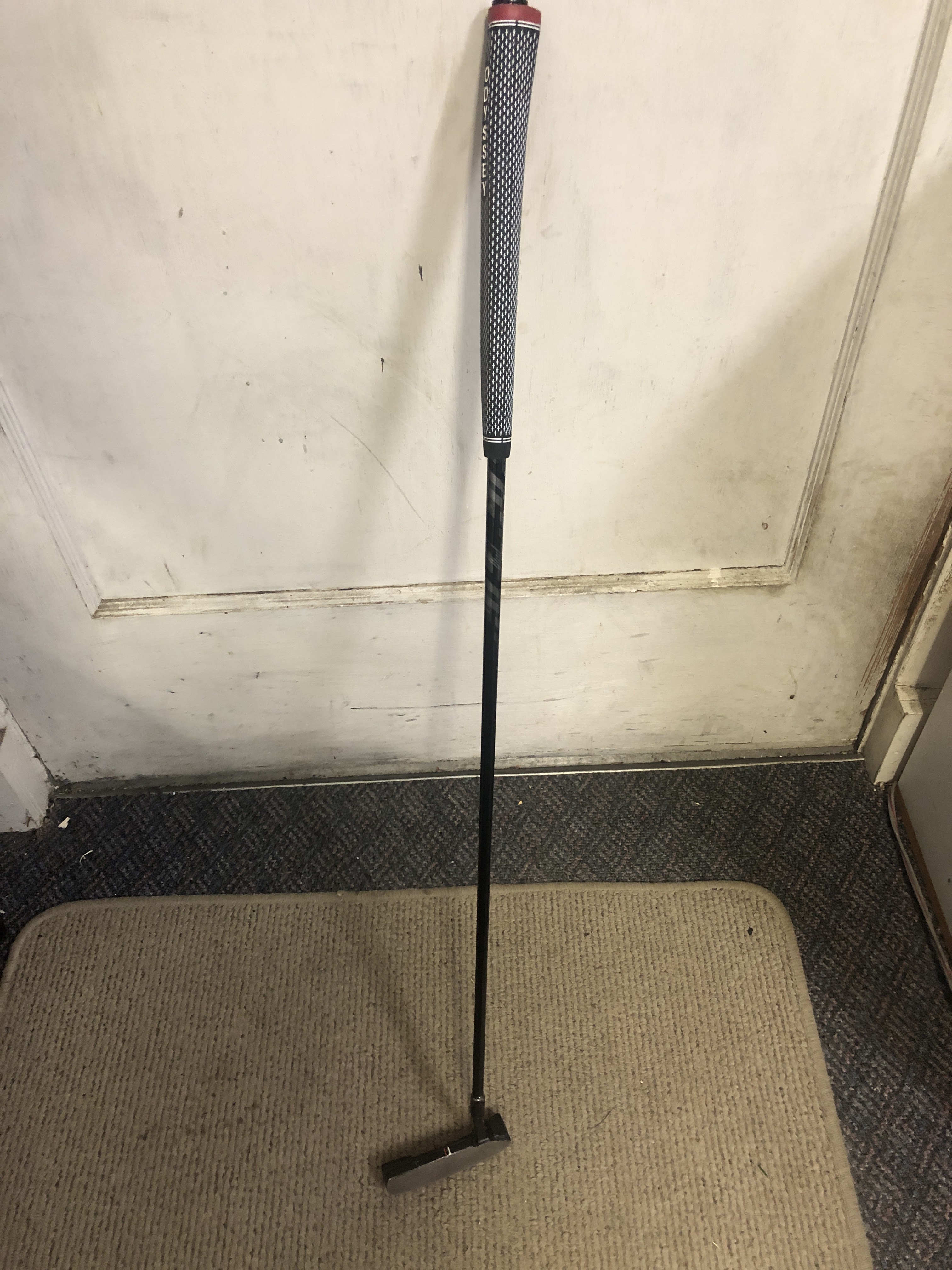
The most recent addition to my stable is a self-built putter based on a Ben Hogan Golf BHB-01 plumber’s neck blade putter head. I installed the shaft that came with my Odyssey Golf Tank Cruiser 1 putter—which was re-shafted, for a while, with an early version of the BGT Stability Shaft (about which more here)—and my preferred Odyssey White Hot pistol-style grip. I drilled out the threaded fitting in the butt end of the Odyssey shaft to allow me more options for counterweighting than just the 15- and 30-gram counterweights that came in the Odyssey’s weight kit, and opened up a hole in the end of the Odyssey grip to allow the fitting of one of the range of Super Stroke Counter Core counterweights (25-gram, 50-gram, or 75-gram). I also filed an alignment mark on the top line and filled it with white paint.

The Odyssey Tank Cruiser, meanwhile, had the BGT Stability Shaft replaced with a $15 standard steel shaft. To reduce toe hang I removed the weight from the toe port in the sole, replacing it with cork, and installed a 20-gram weight in the heel port. I installed an Odyssey White Hot pistol-style grip, and opened up the hole in the butt end to take a Super Stroke counterweight. 

While the Ben Hogan-based putter is a “bitsa” build—put together from “bits of this and bits of that”—the real Frankenstein’s monster in my putter stable is the continuously evolving build that started out as a $17 new-old-stock Tight Lies blade putter that I purchased online. This putter, in one of its several modified iterations, was the one that I had in my bag in May 2019 when I played Pebble Beach during the USGA’s media day for the U.S. Open. It was a day that had its ups and downs, but one in which I had a great round on the greens, with eleven two-putt greens, and four one-putts.

Aside from a bit of tweaking for lie and loft, the first big change for this putter was the installation of the stock Odyssey shaft (with the 30-gram counterweight) when my Odyssey Tank Cruiser was getting fitted with the BGT Stability Shaft. From there I went to a more radical change, cutting down and transplanting a graphite shaft into the Tight Lies head—the shaft, an Aldila 350, came from a donor club: the driver that was part of my first set of garage-sale used clubs. As I explain in my column about the benefits of a graphite putter shaft, removing mass from the middle of the length of the club increases stability and improves speed control; “Frankenstein”, as I have dubbed the Tight Lies putter, was my first test bed for the benefits of this concept.

This putter went through several subsequent iterations that involved increasing amounts of lead tape on the head, with corresponding increases in counterweighting, all intended to bring it up to the same overall mass and swing weight as the modified Odyssey Tank. Damage to the shaft that occurred during a bout of loft/lie adjustment spelled the end of that particular experiment, so I decided to take it a step further.

Enter the latest iteration of the Tight Lies putter, dubbed Frankenstein III. It now incorporates a brand new graphite shaft, this time a Mitsubishi Rayon KURO KAGE Black Parallel iron shaft, stiff flex, .370 tip, cut down to yield my preferred 35-inch total length. To make the installation of a butt-end counterweight cleaner I sacrificed a Super Stroke grip for the threaded fitting which takes the Counter Core family of weights. Previous grip modifications to accommodate a grip weight involved drilling a hole in the butt end of the grip to a size that allowed the threads on the counterweight to bite into the rubber of the grip; gluing in the plastic threaded fitting from a Super Stroke grip makes the installation a bit tidier.

Frankenstein III, in all its glory

Shiny-new stiff-flex graphite shaft

Logo partly covered by the grip
shows that the shaft has been cut down

To complete the build I installed a 75-gram Super Stroke Counter Core weight. With a head weight of 391.8 grams, a shaft weight of 56.2 grams (less than half the weight, and at $29.95 less than 1/6 the cost, of the BGT Stability shaft), a grip weight of 67.2 grams, and an actual 74.0 grams of counterweight (plus a smidge for grip tape and adhesive) yields an all-up weight of 592.2 grams, or about 1 lb 5 oz. Thanks to the lack of the added lead tape that had previously been wrapped around the shaft of the 75-gram counterweight, this is about 20 grams shy of the weight of the previous iteration, and that of the modified Odyssey Tank. Loft remains at -1º, and the lie angle is 1º shy of the USGA limit, at 79º.


The 75-gram counterweight installed
in my preferred Odyssey putter grip

The swing weight of “Frankenstein III” is E5, making it a touch more head-heavy than its previous iteration at E4, and considerably more so than the modified Odyssey Tank, at D4, and the Hogan BHB-01 build, at D0. The new build feels well-balanced, and I have found it to be consistent and controllable when practicing on my office carpet (which stimps at about 13–14); I can’t wait for our current bout of rainy weather to end so that I can go try it out on real greens.

Playing around with putters is considerably easier and less critical than building or rebuilding full-swing clubs; because of the lower forces experienced by a putter during use you don’t have to worry so much about whether you got the crucial head-to-shaft bond exactly right. Even if you don’t go so far as to re-shaft a putter, a little bit of tinkering with counterweights in the grip and lead tape on the head may surprise you with the benefits that are derived from improving the balance of your “flat stick”.

Tuesday, March 7, 2023

So, what IS the worst golf movie ever made?

Last month, on a whim, I started on an online Twitter poll match-play tournament about golf movies, and to give it what I hoped would be a unique twist, I opted to make it a “Worst Golf Movie Ever Made” (WGMEM) poll.

With a little help from Twitter friends who supplied the names of some golf-related movies that I hadn’t heard of before, I put together a list of twenty films, from the earliest I found, the 1951 Ben Hogan bio-flick Follow The Sun, to 2022’s The Phantom of the Open, about a serial imposter (and non-golfer) named Maurice Flitcroft who tries to enter the British Open. For background and accountability, I watched the ones I hadn’t previously seen (when they were available for viewing) and set things in motion.

Composing a match-play breakdown, I opened with two matchups on the first day the much-loved Caddyshack versus its much-reviled sequel, Caddyshack II, and two biographical films about revered golfers of decades past, Bobby Jones: A Stroke of Genius and Follow The Sun. Turnout was okay in that first round, with 69 votes cast in the dueling-Caddyshacks poll, and 37 in the bio-flick matchup. Caddyshack II won in a rout, 64 to 5 (I want to talk to those five people who think that the original Caddyshack is worse than the execrable sequel), and Follow The Sun, which features a fine actor but obvious non-golfer, Glenn Ford, portraying Ben Hogan, the man with one of the most beautiful golf swings ever seen, prevailed over the Bobby Jones story 23 votes to 14.

After that first round it appeared that people lost interest. I get it, folks are busy, but totals of ten, twelve, and then seven votes in the remaining polls in the Round of 16 were frankly disappointing. I mean, I have a little over 2,100 Twitter followers, and out of all those people no more than a dozen could be bothered to take a second or two and click on a poll button? Sigh…

Voting in the Round of 8 was equally disappointing, with a total of six votes cast, and the Semifinal round pulled a two-vote tie in one poll and no votes in the other. Throwing up my hands in frustration I cancelled the final round and declared Caddyshack II, the film with the most votes as WGMEM the winner – despite the fact that it was knocked out in the Round of 8 (in a one-vote “sweep”.)

In the wake of my poll I started thinking about a couple of existential questions relating to golf movies: What is a golf movie? What makes a golf movie a good or bad golf movie (as opposed to a good or bad movie, period)? Digging deep into my memories of a college Film Studies class (fulfilling a Humanities requirement for this Engineering major), I pondered these questions.

As I pondered, I received a bit of feedback (via Twitter DMs) from one contributor, Golf.com correspondent and fellow Bay Area resident Josh Sens. In the 1990s, prior to his current golf-writing gig, Sens reviewed movies for the Oakland Tribune, and he had these thoughts to share about golf movies:

“I think most golf movies suck to the point of being unwatchable. Partly because golf is hard to dramatize and partly because the guys playing the role of pros rarely have believable swings—but maybe also because golfers are boring?”

Josh’s comment about actors with poor golf swings is valid, up to a point, but unless the disparity is obvious, and egregious, it has never been a major sticking point for me.

I have found that golfers can also be extremely picky regarding other details in golf-related movies. Five years ago I was involved in an online discussion about The Greatest Game Ever Played, a golf movie that I think works very well on many levels, but one commenter in the discussion, who was obviously a deep-dive aficionado of golf equipment of that era (the story takes place in 1913) complained that the golf clubs that the actors were using were from the wrong decade (I can’t remember if it was earlier or later), and that the anachronism ruined the film for him.

(I have spotted anachronisms in movies from time to time (the case of archival footage of a Korean-War-era jet crashing on the deck of an aircraft carrier in the 1976 film Midway comes to mind), but though noticeable (and/or laughable) I have never delved so deeply into “anorak” territory that a movie was “absolutely ruined” for me because of such a thing.)

Sports movies in general fall into one or the other of two categories – they are either very specifically about the sport/game itself or a particular athlete or team, or they are framing a story about a more abstract social concept within the context of sport.

Josh echoed some of my own thoughts about golf movies in further comments:

“I remember interviewing the director Ron Shelton about Tin Cup. When the topic of Caddyshack came up, he said, ‘It’s a funny movie but it’s not a golf movie. It’s a movie about social class.’ ”

I guess you could say the same about all sports movies, that the good ones aren’t so much about the sport but about something deeper/more complex.”

I decided to try and split my list of golf movies into those two general categories: movies strictly about golf and/or golfers, and movies that use golf as a vehicle for another story concept:

Movies about golf:

  • Follow The Sun
  • The Caddy
  • Bobby Jones: Stroke of Genius
  • Dead Solid Perfect
  • Tin Cup
  • The Greatest Game Ever Played
  • Tommy’s Honour
  • The Phantom of The Open
  • The Squeeze

Movies that use golf as a metaphor:

  • Caddyshack – class distinction and snobbery
  • A Gentleman’s Game – social climbing/status-seeking
  • The Legend of Bagger Vance – golf as a vehicle for recovery from trauma
  • Golf in The Kingdom – golf as a path to enlightenment
  • Seven Days in Utopia – golf as a vehicle for personal growth
I then found that some of the movies on the list really belong in a third category: just plain crappy movies. The movies to which I assign that dubious honor are:
  • Happy Gilmore
  • Golfballs!
  • Caddyshack II
  • Who’s Your Caddy?

Not that some of the movies on the first two lists aren’t really, really bad—they are. Follow The Sun is painfully earnest, and stars an actor who appears to have never held a golf club in his life before being cast in the film; Golf in The Kingdom takes a book that I find to be a terrible load of New Age drivel and turns it into an even worse movie; Seven Days in Utopia (which I reviewed here) and The Squeeze* are equally bad, for different reasons and in different ways.

The final comments I received from Sens:

Caddyshack is tolerable because it has some good improv sketches by some great comedians but it only ranks high on the list of golf movies because the competition is so weak. Tin Cup is probably the best I’ve seen but it’s only a good film by golf film standards.”

Caddyshack is so ingrained in popular golf culture that I would venture to say that it is not only the most often quoted golf movie ever made, but one of the most often quoted movies of all time—and probably the only golf-related movie to have a book† (two, actually…) written about the making of the movie.

It should come as no surprise that my ultimate choice for WGMEM comes from my off-the-cuff third list of golf-movie types. Caddyshack II condenses the light-hearted “snobs vs slobs” credo of its namesake original into a bitter brew of broadly offensive clichés. Looking at the other two categories, my selections are, from movies about golf – The Squeeze; and from the list of movies that use golf as a metaphor – Golf in The Kingdom.

It gives me no joy to make these selections—not because it is painful to have to pass judgement on movies that someone obviously thought it would be a good idea and a useful expenditure of time and talent to produce, but because they are so painful to watch. They are that bad.

On the other hand, I take pleasure in selecting my favorite films from the two main categories (and here you will see that I am more or less on the same page as Josh Sens – but not necessarily for the same reasons): Tin Cup, from the list of movies that are actually about golf; and Caddyshack, from the list of movies that use golf as a metaphor.

Tin Cup takes the honors in its category for its realistic but humorous examination of the angst and anxieties associated with the game of golf, plus its stellar cast (Kevin Costner, Rene Russo, Cheech Marin, and Don Johnson – not to mention dipping into the ranks of actual pro golfers of the time in supporting cameos; such names as Peter Jacobsen, Craig Stadler, Gary McCord, and even a baby-faced Phil Mickelson) and outstanding writing.

From the other list, movies that use golf as a metaphor, Caddyshack heads the list because of the great – dare I say iconic – comic turns by Saturday Night Live alums Chevy Chase, Bill Murray, Brian Doyle-Murray (one of Bill’s older brothers, and a writer on the film), veteran standup comedian (but feature film newbie) Rodney Dangerfield, relative newcomer Michael O’Keefe in his third feature film, and veteran straight-man Ted Knight.

Golf movies, as a broadly but capriciously defined genre of film, are a very niche product, but within the short list of movies that comprise that body of work can be found a wide spectrum of styles and quality – and probably, something to please just about any golf fan.

------------------------------------------------------------------

* Of which I wrote in another review that went down with the Examiner.com ship: “Golfers who care more about a decent golf swing than plot, dialogue, and character development will probably like this movie just fine, but I’m afraid that its eventual place in the golf movie spectrum will, in the long run, find it occupying a spot closer to The Foursome than to Caddyshack or Tin Cup.”

Caddyshack – The Making of a Hollywood Cinderella Story, by Entertainment Weekly movie critic Scott Nashawaty, is a fascinating deep dive into not only the making of the movie, but the Harvard Lampoon and Saturday Night Live roots of the filmmakers and cast.

Saturday, August 6, 2022

The Ben Hogan name disappears—again—from the golf equipment landscape

I have some sad news for fans and aficionados of Ben Hogan golf clubs—the Ben Hogan Golf Equipment Company is no more.

Sometime around the middle of July (I learned of it on the 19th), the Ben Hogan Golf Equipment Company’s website started displaying a banner which stated that they were experiencing problems with their website and were unable to process orders.

The iconic Ben Hogan signature script logo has again
disappeared from the golf equipment landscape.

In the days that followed, the news broke that the company had closed its doors and laid off all of its employees. As it turns out, they had lost their funding partner, a company called ExWorks Capital, LLC, which was the majority shareholder and manager of the board for the Ben Hogan Golf Equipment Company. Risky investments during the pandemic, it is said, led to ExWorks ceasing to provide funding support for Ben Hogan, and in March 2022 ExWorks declared bankruptcy. The BHGEC had been in the process of expanding its offerings, including the return of a Ben Hogan golf ball, but without the funding support of ExWorks—so the story goes—the company didn’t have the capital to weather lean times between surges in equipment sales. After trying and failing to secure funding from another source, the company was shut down.

The Ben Hogan name is actually owned by Perry Ellis International (PEI), an apparel company, and was used by the BHGEC under a license agreement with them. PEI have issued a press release, hosted at the former website of the BHGEC, which states that they are seeking “a new licensee for this golf equipment product category” and that they are “exploring options for a new club manufacturing partner while exploring the current market for future opportunities.”

Call me paranoid, but to me this smacks of a business maneuver designed to slap down the existing golf equipment company, which had been flourishing under the leadership of Scott White, so that PEI could pull the manufacture of hard goods under the Ben Hogan name beneath their umbrella, and I fear that their “new club manufacturing partner” will be some Chinese knockoff shop whose cheap labor and government-supported facilities maximize profits at the expense of the design excellence and build quality that the Ben Hogan name has always stood for.

I feel lucky, now, that I decided last fall to purchase a set of the Ben Hogan Edge Ex irons that I reviewed around this time last year, and most recently, one of their excellent utility clubs, the 22˚ 4UiHi driving iron, clubs which joined my Ben Hogan GS53 Max driver and classic Sure Out 60˚ lob wedge to make my current bag 64% (9/14) Hogan clubs.

Whether the iconic sunburst and script signature logos ever return to the golf equipment landscape remains to be seen, and if they do I sincerely hope that they do so in a manner, and with equipment, that does justice to the name and legacy of one of the greatest that has ever played the game of golf.

Tuesday, September 21, 2021

Ben Hogan owns a unique Ryder Cup record that may never be equaled


While the eyes of the golf world are focused on the Ryder Cup this week, I thought that it would be fun to pull away from the drama of the current year’s events to take a look at some Ryder Cup history, and ask a question. What constitutes the “best” record in the Ryder Cup? Is it the most wins, or the most points scored over time? Or is it a perfect record, unblemished by losses, or even halves? And if it is the latter, who has achieved such a record?

Well, I can tell you that only one man has, and I’m willing to bet that most golfers, if asked who that man was, would guess and toss out names like Nicklaus, Palmer, or Woods from the American side; or Faldo, Ballesteros, or Montgomerie from the GBI/European side—but they’d be wrong.

That man is Ben Hogan.

Ben Hogan at the 1967 Ryder Cup awards ceremony
Credit: PGA of America via Getty Images    Copyright: PGA of America


Hogan is not a name that comes up much in conversations about the Ryder Cup these days, but it should. The American players who are most strongly associated with the biennial competition include Jack Nicklaus, Paul Azinger, and Phil Mickelson; on the GBI/European side you’ll hear about Seve Ballesteros, Nick Faldo, Colin Montgomerie, and Ian Poulter. Ben Hogan didn’t play in as many Ryder Cups as those big names, or score as many points, but he has one distinction that none of the rest of them can match: he was undefeated, both as a player and as a captain.

****************

The 1947 Ryder Cup marked the return of the event to the world stage for the first time since 1937, and Ben Hogan’s first appearance in the event, as a playing captain—he remains the only man to have been chosen to captain the American squad without having played on a previous team. Foursomes and singles were the only matches that were contested in those days, and Hogan played in only one match, teaming up with good friend Jimmy Demaret in a foursomes match against Jimmy Adams and Max Faulkner, defeating the GBI duo 2-up.

Played at Portland Golf Club, in Portland, Oregon, the 1947 event was marked by controversy that came at playing captain Hogan from both sides. First, American player Vic Ghezzi, perhaps disgruntled by the serial disappointment of having been selected for three consecutive Ryder Cups that were cancelled by the war—19391, 1941, and 1943—complained that he had been discriminated against by Hogan when the captain eliminated from consideration for qualification the results of several invitational events in which Ghezzi had finished well.[i]

Second, Ghezzi also accused Hogan of pressuring tournaments to ease restrictions on the alteration of grooves on wedges, an infraction that Ghezzi had been accused of earlier that year, an accusation that was reported in the press. It is possible that these reports encouraged GBI captain Henry Cotton in alleging that the Americans were using clubs with illegal grooves. This accusation came to naught when Captain Hogan allowed the Americans’ clubs to be inspected, and all were found to be legal and conforming.

****************

Hogan’s next appearance in the Ryder Cup came in 1949 as a non-playing captain—the youngest, to this day, in the history of the event. Just seven-and-a-half months after the February, 1949 head-on collision with a Greyhound bus that had come close to claiming his life, Hogan led a nine-man team consisting of four veterans; Sam Snead, Jimmy Demaret, Lloyd Mangrum, and Dutch Harrison, and five rookies; Skip Alexander, Bob Hamilton, Chick Harbert, Clayton Heafner, and Johnny Palmer, against a 10-man GBI squad of eight veterans and two rookies.

The event was again marked by some controversy, on two counts: First, Hogan reopened old wounds from the 1947 Ryder Cup when he leveled charges, on the night before play was to begin, that some of the British players were using irons with grooves that were deeper than were allowed by the rules. Unlike Henry Cotton’s accusation in 1947, the charges were found to have some merit: Jock Ballantyne, the head pro of the host club, Ganton Golf Club in Yorkshire, reportedly stayed up half the night grinding the faces of several sets of clubs to bring the grooves into conformance.

Second, the U.S. team brought along their own provisions, including fresh butter and eggs, half a dozen Virginia hams, thirty pounds of bacon, and some six hundred pounds of Texas sirloin steaks, to a United Kingdom that was still subject to wartime food rationing. The furor surrounding this culinary affront died down when Hogan offered to share the American bounty with the host team.

This was still in the era of foursomes and singles matches only, and while the GBI squad led 3-1 at the end of the Friday foursomes, the U.S. team rallied back in the Saturday singles, winning six of the eight matches to post an overall winning record of 7 and 5.

****************

Hogan returned to Ryder Cup play in 1951 as a team member. Though thankfully unmarked by controversy, the 1951 event did score an oddity— play was split between Friday (foursomes) and Sunday (singles) so that participants and spectators (presumably) could attend a college football game on Saturday in nearby Chapel Hill, where home team North Carolina hosted the visiting Tennessee Volunteers.

The U.S. team went out to a 3–1 lead in the Friday foursome matches, Hogan and good friend Jimmy Demaret teaming up once again and defeating the GBI duo of Fred Day and Ken Bousfield, 5 & 4.

Despite their strong play on Friday (the three matches they won went 5 & 3, 5 & 4, 5 & 4), the American Ryder Cup squad stayed in Pinehurst and practiced on Saturday, while the visiting GBI squad attended the American football game (and likely wondered at the name, given that only one member of the team ever touches the ball with his foot.) The visiting team, Tennessee, won in a rout, 27–0, but any hopes of foreshadowing for the GBI Ryder Cup squad was crushed during Sunday’s singles matches.

The U.S. team dominated the Sunday singles, 6-1-1, adding 6½ points to their Friday total for a 9½–2½ trouncing of the GBI squad. Hogan, playing in his first, and only, Ryder Cup singles match, defeated Britain’s Charlie Ward 3 & 2. It was to be the last Ryder Cup point he ever scored.

****************

Hogan didn’t return to the Ryder Cup until 1967, when he took the U.S. squad down the road to Champions Golf Club in Houston, Texas as a non-playing captain.

Not taking it any easier on his team than he ever had on himself, Hogan imposed a 10:30 pm. curfew and early practice sessions on his squad of five veterans and five rookies.

It was evident, however, that Hogan had confidence in his team. At the opening night dinner, after GBI squad captain Dai Rees, a loquacious Welshman, waxed lyrical (and overlong) about the virtues of each of his players in his introductory remarks, Hogan kept his speech short and sweet. After introducing each player by name only, and with his entire team standing, Hogan said, “Ladies and gentlemen, the U.S. Ryder Cup Team—the finest golfers in the world.” 

There was noticeable friction between Hogan and one of his players, though: Arnold Palmer. The two had always had a frosty relationship, and a couple of incidents during the 1967 Ryder Cup only deepened the permafrost.

In an interesting move that would form the basis of the one question I would most like to ask Mr Hogan, given the chance, he opted for his team to play the smaller (1.62-inch diameter) British ball, as was the option in those days.[ii] The decision to play the smaller ball led to a bit of internal controversy between Hogan and Palmer. Details of the exchange vary, but allegedly when Palmer, who had obviously forgotten to practice with the 1.62-inch ball, asked Hogan if he had brought any, Hogan snapped back, “Did you remember to bring your clubs?”[iii]

Of course, it probably hadn’t helped things that Palmer had shown up a couple of days late for practice rounds, and then took a few members of the GBI squad up for a ride in the Rockwell Jet Commander aircraft that he had bought the year before.[iv] After climbing to 8,000 feet and rolling the aircraft, Palmer circled dangerously low over the golf course on final approach before landing. Billy Casper was on the course at the time, and later recalled that when Palmer flew over in the jet, with his wheels down, he was so low that, “I could have hit a wedge over that plane.” Tournament host and Champions Club co-founder Jimmy Demaret quipped, “The only time I’ve ever seen a plane fly under the eaves of a clubhouse.”[v]

The stunt earned Palmer a letter of severe reprimand from the Federal Aviation Administration, and a rebuke from Hogan.

After Palmer and partner Gardner Dickinson won their Friday foursomes matches 2 & 1 over the Anglo/Irish duo of Peter Alliss and Christy O’Connor in the morning, and 5 & 4 over another Anglo/Irish pairing, Malcolm Gregson and Hugh Boyle in the afternoon, Palmer was sat out in the morning for the Saturday fourball (better-ball) matches, a 1963 addition to the Ryder Cup format. This is often seen as a slight against Palmer, who agreed in public with his captain’s decision, and later admitted in private that he was a bit tired.[vi] Julius Boros, who had 14 PGA Tour wins to his credit by this time, and two U.S. Open wins (1952, 1963) also sat out Saturday morning after playing morning and afternoon on Friday.

Saturday afternoon saw the two rested players, Palmer and Boros, paired up against Scotsman George Will and Irishman Hugh Boyle in a hard-fought match. The American pair were 4-down at the turn, and battled back to a 1-up win that was the closest U.S. victory of the afternoon.

The Sunday singles matches were dominated by Captain Hogan’s American players 5–3 in the morning and 5½ –2½ in the afternoon, for an overall score of USA–23 ½, GBI–8 ½.

****************

Ben Hogan’s record of three Ryder Cup wins doesn’t sound too impressive compared to the points totals toted up by some modern-day players, but his opportunities to rack up points was limited by the war years, and by the fact that his Ryder Cup playing days came before the addition of a day of fourball matches between foursome and singles. In one category, though, he stands out above all others: he is the only man whose Ryder Cup record, both as a player and a captain, has that pair of zeroes after the win count: 3–0–0. 

Ben Hogan – undefeated.


[i] Dodson, James; Ben Hogan: An American Life, pg. 213

[iii] Sampson, Curt; Hogan, pg. 229

[v] Dodson, James; Ben Hogan: An American Life, pg. 475

[vi] Feherty, David & Frank, James A.; David Feherty’s Totally Subjective History of the Ryder Cup, pg. 146

Friday, August 27, 2021

Equipment Review: Edge EX irons from Ben Hogan Golf ⭐️⭐️⭐️⭐️⭐️

August 5th, 2022: I felt that I should post an update to this article to share some sad news – the Ben Hogan Golf Equipment Company is no more. I wrote about it here.

****************************************

Let’s get this out of the way right from the start—I am a big fan of everything Ben Hogan. Though I first got my hands on a golf club in junior high school, I didn’t really get interested in golf until about 18 years later, when I was introduced to the golf writing of the legendary sportswriter Dan Jenkins.

Jenkins, like Hogan a native of Fort Worth, Texas, started covering Hogan’s career as a college freshman writing for the old Fort Worth Press. His admiration for Ben Hogan rubbed off on me through my reading, and my interest in all things Hogan eventually extended to the golf clubs manufactured by the company Hogan founded in the early 1950s, Ben Hogan Golf.

Over the years I have acquired four sets of Hogan irons of various vintages (most recently a nice 3–PW set of Hogan Apex Plus cavity-back irons with the rare Apex 4 graphite shafts), so it was with much interest that I followed the revival of Ben Hogan Golf as an equipment manufacturer back in 2016. I tested and reviewed their original Fort Worth irons back then, and was very impressed by their design, build quality, and performance, even though I felt that their use of loft numbering rather than traditional club-numbering designations was a bit odd.

Jump forward five years to 2021 and we find the reboot of the Ben Hogan Golf Company going strong, having defined the direct-to-consumer business model for golf clubs. I have been keeping my eye on the company’s offerings since 2016, and a couple of months ago I took advantage of their demo program to try (and buy) my first new driver in more years than I care to admit. When I first saw the new Edge EX irons I knew I would have to try them, too.

Why the Edge EX?

I was drawn to the Edge EX, Ben Hogan Golf’s new entry in the “Game-Improvement Irons” category, by their resemblance to the Apex Edge irons of the original Ben Hogan Golf Company (of which I own a pair: new-old-stock 5-iron and 6-iron with Apex 4 graphite shafts), and by the fact that though they are labeled “game improvement” they don’t have that “shovels for duffers” look that is so common to many entries in the category.

The hybrid cavity/muscle-back “Open Cavity” design, which the Edge EX has in common with the Apex Edge of 20 years ago, is a proven way of combining the low/rearward mass placement that is instru-mental in helping get a ball up in the air with the (moderately) wide sole that helps make these clubs friendly in the hands of mid-to-high handicappers.

The open-cavity back and perimeter weighting of the new Ben Hogan Edge EX irons combine for its high-launch characteristics and forgiveness on mishits. (Photo by author)

Speaking of the sole, the Ben Hogan V-Sole design, which combines a high-bounce leading edge with a low-bounce trailing edge, is a big contributor to the player-friendliness of the Edge EX, easing turf inter-action across a wide range of conditions.

The dual-camber Hogan V-Sole design helps the Edge EX irons work smoothly through a wide range of turf conditions. (Photo by author)


The thickish topline of the Edge EX, while a feature that is disparaged by aficionados of butter-knife blades, is evidence of yet another “friendliness factor” design feature: the perimeter weighting which increases forgiveness on mishits.

While some may not care much for the topline view of the Ben Hogan Edge EX irons, the perimeter weighting that it represents increases forgiveness on mishits. (Photo by author)


Other features I like are the lofts and gapping which are employed in the Edge EX design. The people at Ben Hogan Golf believe in con-sistent gapping—all of their iron sets use 4º loft increments—and the Edge EX irons use lofts that are two degrees stronger than their Icon and PTx Pro irons for that little bit of extra help, distance-wise, for the players for whom these clubs are designed. (It is worth noting, how-ever, that the Edge EX lofts are two to three degrees weaker than offerings in the same category from most other manufacturers.)

Personally, I think that a high launch is more desirable than the potential distance gain from jacked-up iron lofts, and higher-lofted irons are easier to hit, so Edge EX lofts that are only a couple of degrees stronger than Hogan’s player’s irons seem a reasonable compromise to me.

Demo-ing the Edge EX

I took advantage of Ben Hogan Golf’s demo program to try out the Edge EX for myself. As part of the tryout I did a bit of a comparison test against the 7-iron from my current gamers, the Sub70 Golf 639 CB irons with stiff KBS Tour-V 90 shafts, as well as the 7-irons from three of my sets of vintage Hogan irons: Apex Plus with Apex 4 (stiff) steel shaft, Apex Plus with Apex 4 graphite shaft, and Edge CFT with Apex 3 (regular flex) graphite shaft. My demo Edge EX 7-iron was fitted with the KBS Tour 90 S-flex shaft.

I chose to play off the Edge CFT, a lesser-known offering from the old Hogan Company, against the Edge EX because it is a similar open-cavity design, but with a Compression Forged Titanium (ergo “CFT”) face brazed into a stainless-steel body. The use of strong, lightweight titanium for the face, in conjunction with the open cavity back and perimeter-weighted design, maximized forgiveness in these clubs which were, in my estimation, ahead of their time and never fully appreciated for their playing qualities.

In two range sessions with the Edge EX and my lineup of comparison clubs I particularly noted the similarity in feel and ball flight between the Edge EX and the Edge CFT, which I attribute to the similarities in design shared by the two. Both feature a high, controllable ball flight and a smooth feel at impact (even if you’re not wearing a nickel-sized bald spot into the center of the club face.)

The loft of the Edge EX 7-iron, at 32º, was two degrees stronger than the clubs I was comparing it to, and relying on eyeball evaluation of ball flight alone I judged it be similar in distance, with higher ball flight (in my hands), especially compared to the older Apex Plus irons, regardless of shaft material. The V-Sole design of the Edge EX allowed the club to work smoothly through even the less-than-ideal turf conditions at the range where I was testing the club (they move the ropes on Mondays, but I was only able to get to the range on weekends—because I still have a day job—so the hitting areas were generally a bit chewed up.)

Despite its standard lie and regular-sized grip, rather than the 1º flat and midsize grip that is my preferred setup, I found the demo Edge EX to be a comfortable, consistent club to play with, and even in the hands of this high-handicapper (slightly higher than average, I admit—I need to get out and play more golf) it is workable, right and left, if you feel the need to play with ball-flight shape.

The bottom-line result of my club testing of the Edge EX—two range sessions, comparing shots to some vintage Hogan irons and my current Sub70 gamers—is that slightly more than a year after buying the Sub70s, I am contemplating the purchase of another new set of irons.

To be honest, if the folks at Ben Hogan Golf were to combine the updated open-cavity design of the Edge EX with the titanium face technology of the 2003-vintage Edge CFT, I wouldn’t be thinking twice about that purchase.


Wednesday, March 17, 2021

Comparisons of Tiger Woods’ recent crash to Ben Hogan’s 1949 crash are inevitable, but flawed

Not long after I first heard about Tiger Woods’ recent car crash, I began to dread the inevitable comparisons to Ben Hogan’s well-known crash, on February 2nd, 1949—and they weren’t long in coming. What I didn’t anticipate was a validation of their similarity, even with qualifications, from James Dodson, the author of one of the two most notable biographies of Ben Hogan. In response to queries of, “Isn’t this like history repeating itself?”, Dodson replied (in this column: With Crash Came Echoes of Hogan) with a qualified “yes”:

“…there are striking similarities in these tragedies as well as eerie echoes of each man’s struggle to reach the summit of the game only to pay a price for becoming the best in the world. In each case, though they were stars from very different eras, both also experienced something of a personal awakening—even redemption—along the way.”

(Insert face-palm emoji here.)

Right off the bat I take issue with the characterization of Woods’ February 23rd, 2021 crash as a tragedy. The injuries to his right leg, though serious, were not life-threatening, and no medical opinion has been expressed that casts serious doubt on his ability to walk or play golf again. There has been a lot of speculation about his ability to come back and play as well as he has in the past, but frankly, due in large part to his multiple back surgeries (the cumulative result of the violent lashing action of his swing over many years), his best years are well behind him, and have been for over a decade.

Woods’ crash can only be construed as a tragedy by sycophantic fans who consider him the be-all and end-all of the game of golf, and by any reasonable estimation can only be construed as being his own fault.

On the other hand, Hogan’s crash, which was entirely the fault of the driver of that Greyhound bus, came within a hairsbreadth of being a tragedy in the event, as only the last-second act of flinging himself across the seat to shield his wife preventing his being crushed against the back of the seat by the steering wheel and steering column of the car as they were shoved into the passenger compartment by the impact. There could still have been a tragic result in the aftermath of the crash, because his life was threatened by blood clots that formed in his damaged lower body and moved to his heart and lungs. Only timely intervention in the form of a complex, invasive surgical procedure, which saved his life but impaired the blood flow to and from his legs, prevented an ultimate tragic result for Hogan.

*********************************

I am also having a problem with the comparison related by the statement “…eerie echoes of each man’s struggle to reach the summit of the game only to pay a price for becoming the best in the world.”

How can Hogan’s crash be construed as “…pay(ing) a price for becoming the best in the world”? Don’t bother answering, I will: it can’t. It was the sort of thing that could have happened to anyone who happened to be driving along with all due care only to be victimized by the carelessness and poor judgement of another driver.

On the other hand, Woods’ latest automotive mishap, as well as the others, involved only himself (thankfully) and some combination of drugs and the consequences of his own bad judgement and bad behavior. Looked at in a certain way, refracted through a prism of fanboyish worship and a willful disregard for assigning fault, Woods’ most recent crash could be construed as arising from his well-publicized ruthless pursuit of perfection, and his frustration at not living up to his self-imposed goals. Entire books have been (and will continue to be) written about this.

The bottom line on that aspect of the issue is that Hogan achieved arguably his greatest professional and personal success after the car crash that left him with life-threatening complications. He was in the hospital for 59 days and at great risk of never being able to play golf again, yet he came back to rack up 11 wins (of which six were majors) in the six years following his accident, and this on a limited schedule—for example, in 1951 he played only five tournaments, and won three of them (including the Masters and the U. S. Open).

Woods’ return after the fire-hydrant incident and the subsequent implosion of his personal life and public reputation looked like this: two winless seasons in 2010 and 2011, then a mini-comeback with three and five wins, respectively, in 2012 and 2013 (playing 19 and 16 events in those years), before another round of back injuries and personal complications brought on the longest winless stretch of his career, from 2014 to 2017. 

*********************************

Ben Hogan’s personal awakening in the wake of his crash consisted of a man who had always been something of a loner realizing that he had fans, that people liked him and were pulling for him to recover from the horrific injuries he had suffered. It was a sea change in his outlook on life that helped him persevere through his recovery and subsequent return to championship form.

Woods’ personal awakening in the wake of either or both of his earlier traffic misadventures, to the extent that he had one, was more along the lines of, “Holy s**t, I may lose sponsors (reader, he did…) if I don’t get my act together!” Woods also engaged in rehabilitation for substance and sex addictions, as a well as a public (and painful) mea culpa as a bone thrown to the general public (and potential future sponsors).  

*********************************

Ultimately, the only similarity between the two events lies in the fact that they were vehicle crashes that involved a professional golfer; the differences are much more significant.

Ben and Valerie’s Cadillac was plowed into by a Greyhound bus when an inexperienced bus driver attempted to unsafely pass a truck, on a bridge, in foggy, low-visibility conditions, to make up time and keep to his schedule. 

Tiger’s crash took place at approximately 7:12 am on a clear sunny day, on a lightly traveled (in these pandemic times) road that was dry and in good condition. The physical evidence at the scene indicated that his vehicle continued in a straight line as the road curved gently to the right, crossing a low median divider and two opposing-traffic lanes (luckily, there were no other vehicles in those lanes at the time), exiting the roadway, taking out a tree, and flipping/rolling to a stop in the “natural area” adjacent to the roadway.

So what caused it? Was it impairment? Inattention? Speculation is rampant, and fueled partially by the actions (or inaction) of the L.A. County Sheriff’s Department.

The LACSD declined to obtain blood toxicology information when Woods was taken to a local hospital, relying instead on the assessment of a deputy on the scene—a deputy who was untrained in the identification of clues of impairment—who said that Woods seemed lucid and in possession of his faculties in the aftermath of the accident.

Independent traffic-accident investigators who have reviewed the available information about the incident have questioned that decision, and late-breaking information about Woods’ responses, specifically  the fact that he twice told deputies on the scene that didn’t remember how the accident happened and didn’t even remember driving, have raised further questions.

Woods is known to have had issues with the sleep aid Ambien in the past, a medication which carries a warning about impairment a day after taking it, impairment that includes disorientation and memory loss.

Several articles published in the weeks following Woods’ crash have stated that investigators have sought access to the vehicle’s so-called “black box” (actually an event data recorder, or EDR), but that device is unlikely to tell them much that cannot already be gleaned from the evidence at the accident site. An EDR collects data such as vehicle speed, throttle position, brake application, airbag deployment, seatbelt use, steering angles and other data for a period of about 20 seconds before the crash, during the crash, and 20 seconds after the crash.

This type of information is used by vehicle manufacturers to determine if a mechanical malfunction was a contributing factor in a crash, but it is not necessarily going to be strongly indicative of human-error factors that may have precipitated an incident. For that, other avenues of investigation have to be pursued.

Phone records, and blood toxicity reports (if available), would allow investigators to determine if inattention or physical impairment were causal factors—and should be pursued. If another vehicle had been involved and innocent people in that car had been injured or killed these factors would certainly not have been ignored. Even lacking that complication the seriousness of this accident would warrant a thorough investigation to determine its cause in order to support a charge of DWI or reckless driving.

*********************************

I’ll be honest—I have never understood the rah-rah enthusiasm of Tiger’s fan base, which drove a frenzied outpouring of well-wishes and “thoughts and prayers” comments that has washed over social media like a tidal wave in the three weeks since he crashed that SUV. Of course only a sociopath wouldn’t wish him as complete a recovery as possible, if only for the sake of his future life as a parent to his two kids, but the level of grief and outpouring of emotion for injuries that weren’t life-threatening surpasses understanding in my book, especially when those injuries were his own fault.

Various columns that have come out since the crash have warned Woods’ fans not to expect a rousing comeback—an assessment that is based on: a) his age, and b) the pre-existing physical issues that have already taken their toll on his game, so the apex of their hopes, that he will equal or surpass Jack Nicklaus’ record of 18 major victories, is essentially out of the question.

*********************************

To reiterate: the cold, hard fact of the matter is that the only commonalities between the crash that broke Tiger Woods’ leg and the crash that narrowly missed claiming the lives of Ben Hogan and his wife, Valerie, is that they were automobile crashes that each involved a professional golfer. The two men were in very different places in their careers when their respective crashes occurred, and the incidents happened under very different circumstances, for very different reasons—namely, Ben Hogan was hit by a bus, and Tiger Woods threw himself under one.

Sunday, April 5, 2020

If You Can’t Play Golf, Read About It – A Recommended-Reading List of Golf-Related Books

In this time of shelter-in-place and social distancing, with people turning to indoor pursuits as their chosen outdoor pursuits are, largely, curtailed for the duration of the health emergency, “Top 10” lists of movies to TV shows to watch, or books to read, are flourishing. Since I publish two blogs, one on golf and another on books, what is more appropriate than for me to publish a golf-book reading list of my own? Here then, in no particular order, is my personal rundown of golf books that I have found to be especially rewarding to read, with a brief description of each.

Let’s start with the man who started it all for me, Dan Jenkins:

Dead Solid Perfect, by Dan Jenkins
This is the book that was my introduction to Dan Jenkins’ work, and to golf writing in general. Dead Solid Perfect was recommended to me by the father of a girl I was dating, years ago, with this caveat, “Don’t read it anywhere where laughing out loud will bother other people.” I went out and bought a copy, and read it straight through over a weekend. It lived up to its billing.

A bit raunchy in parts (though not a patch on Jenkins’ big football-based bestseller, Semi-Tough), and far from politically correct at any time, DSP relates the adventures of Fort Worth-based pro golfer Kenny Lee Puckett—growing up in Fort Worth, pursuing life and love on the pro golf circuit, and making a run at the U.S. Open title. (If the name sounds familiar, Semi-Tough’s pro football player protagonist Billy Clyde Puckett is Kenny Lee’s nephew.)

DSP is the genre-defining grandaddy of all golf novels; no golf-reading list can be considered complete if it does not include this book.

More by Dan Jenkins:


NOVELS
The Money-Whipped Steer-Job Three-Jack Give-Up Artist: Winner by two lengths for the “longest title in my bookcase” prize, this book is kind of Dead Solid Perfect, Pt II. Published in 2001, just shy of 40 years after the publication of Dead Solid Perfect, Jenkins revisits familiar territory with another Fort Worth-based pro golfer, Bobby Joe Grooves, who is on a quest for a spot on the U.S. Ryder Cup squad.

Slim and None: Bobby Joe Grooves is back in this 2005 sequel, with a new girl friend, and a new quest—a major championship title and membership in an exclusive club: major winners aged 44 and over.

The Franchise Babe: Jenkins switches gears in this 2008 novel—instead of a pro golfer from Fort Worth, his protagonist is a golf writer from Fort Worth who has jumped the fence from the PGA Tour to cover an up-and-coming young LPGA star. Predictable, maybe; but also funny in Dan’s resolutely non-PC manner. Look for a cameo appearance by a thinly disguised Ron Sirak, a good friend of Dan’s who has worked the LPGA beat for years.

NON-FICTION
The Dogged Victims of Inexorable Fate: The classic, must-read collection of golf essays, some real, some fictional. Dan’s second book, written in 1970, contains the single best comic essay on golf ever written, “The Glory Game”.

Fairways and Greens: This 1994 collection of Dan’s writing is divided into two sections: essays on the (then) current-day game, and a “nostalgia” section, heavy on the Hogan (of course!) Also contains a reprint of “The Glory Game” re-titled as “The Glory Game at Goat Hills”.

Unplayable Lies: Another collection of essays, published in 2015. Half existing works that had appeared previously in Golf Digest or Golf World (in some cases slightly updated or reworked for the book), the other half new work, written specifically for this book.

Jenkins at the Majors: Another collection of Dan’s work, 94 of the brilliant, written-on-deadline pieces on golf’s majors, written for the Fort Worth Press, Dallas Times Herald, Sports Illustrated, and Golf Digest that he turned in during his career as a newspaperman and magazine writer—during which he covered 232 majors—arranged chronologically and chosen for the historical significance of the particular event.

Mr Hogan, The Man I Knew, by Kris Tschetter
This 2010 volume by LPGA player Kris Tschetter is unique in the Hogan bibliography, relating as it does how South Dakota-native Tschetter became acquainted with Hogan while she was on the golf team at Texas Christian University in Forth Worth. She and her older brother, Mike, who also played golf for TCU, were gifted junior memberships at Shady Oaks Golf Club—Hogan’s golf hangout in his retirement years—by their parents. Hogan noticed Kris for her diligent practice sessions (one of his trademarks) and they became sometime practice partners. Kris and Mr Hogan remained close for the remainder of his life, and her stories of their time together and his surrogate-grandfather role in her life are heart-warming and genuine.

I haven’t conducted a formal count, but Ben Hogan and Arnold Palmer have to be running neck-and-neck in the number of books that have been written about them, Palmer because he was so open and charismatic, and Hogan because he was pretty much the opposite (or at least perceived that way), so this book is important for the depiction of a side of Ben Hogan that few knew existed.

For more on Ben Hogan, I recommend two fine (though very different) biographies, Hogan, by Curt Sampson, and Ben Hogan: An American Life, by James Dodson; also Grown at Glen Garden, by Jeff Miller, about Hogan, Byron Nelson and the Fort Worth golf course where they both grew into the game; and Miracle at Merion, by David Barrett, which relates the story of Hogan’s comeback from a near-fatal 1949 automobile collision, leading to the much-lauded 1950 U.S. Open victory at Merion Golf Club, near Pittsburgh, Pennsylvania.

Men in Green, by Michael Bamberger
This 2015 book by (now-former) Sports Illustrated writer Bamberger is a delightful road trip around the United States to connect with some legends of the game of golf, both well-known and little-known/unknown. The names involved run the gamut from Arnold Palmer to Dolphus Hull. It is full of Bamberger’s wry observations and enlivened by his deep knowledge of and love for the game of golf. (The talks he had with Arnold Palmer are themselves worth the price of the book.)

More by Michael Bamberger: 

The Green Road Home: Bamberger’s first book, published in 1986, is about the six months he spent caddying in the PGA Tour the previous year, at the age of 24. Twenty-three tournaments, including the British Open and the PGA Championship. Caddying for a disparate array of players such as Al Geiberger, George Archer, Brad Faxon, and Steve Elkington. It is a great look at a bygone time in pro golf, and the beginning of the career of one of the best writers in the game of golf today.

To The Linksland: Six years after The Green Road Home, Bamberger and his adventurous and very understanding wife, Christine, left their office jobs—he a reporter for the Philadelphia Inquirer, she a New York ad executive—to see the other side of golf: Scotland, the Continent, and the European Tour. It is an adventurous travelogue, and a journey to the heart and soul of the most soulful game in the world.

This Golfing Life: A stirring retrospective, published in 2005, looking back at twenty years in golf, from caddying in his twenties to reporting for the Philadelphia Inquirer, where he covered golf part-time, before moving on (and up) to Sports Illustrated.

Bud, Sweat, and Tees, by Alan Shipnuck
Former Sports Illustrated writer, now wielding a pen for Golf.com, my fellow Salinas, California native Shipnuck can always be counted on to find a quirky story among the goings-on in the world of professional golf. This book, which follows PGA Tour pro Rich Beem’s early career, from his 1999 rookie season to his early (and ultimate) peak as the 2002 PGA Championship winner, is a great example. It’s a crazy ride from Beem’s stint as a minimum wage cellphone salesman, to hooking into the wilder side of life on the PGA Tour accompanied by his equally hard-living caddie Steve Duplantis.

More by Alan Shipnuck:
Swinging From My Heels – Shipnuck collaborated with San Jose, California native Christina Kim on this inside look at the 2009 LPGA Tour. Kim, the youngest LPGA player in history to reach one million dollars in career earnings—back when a million bucks was still a lot of money—has never been one to pull a punch, and this no-holds-look at a season on the distaff Tour raised some eyebrows when it came out in 2010.

The Battle for Augusta National: Hootie, Martha, and the Masters of the Universe – The first book by Shipnuck explored the Hootie Johnson/Martha Burke controversy that affected the 2003 Masters golf tournament.

The Swinger—A collaboration with (then-)fellow SI scribe Michael Bamberger, this roman-á-clef novel is thinly-disguised run at the infamous trials and tribulations of Tiger Woods.

The Greatest Game Ever Played, by Mark Frost
The inspiring story of Francis Ouimet, the 21-year-old American amateur golfer who defeated two titans of golf, England’s Harry Vardon and Ted Ray, to take the 1913 U.S. Open title. The account of how Ouimet, accompanied by his 10-year-old caddie, Eddie Lowery, took down these two giants of the game in a nerve-wracking playoff at The Country Club, in Brookline, Massachusetts, is a sports story for the ages.

More by Mark Frost:
The Grand Slam: Bobby Jones, America, and the Story of Golf – No name in American golf resonates more strongly throughout the game than that of Bobby Jones. Frost delves deeply into the life of this American sporting icon in this well-received 2004 biography.

The Match: The Day the Game of Golf Changed Forever – Though I have always felt that the event doesn’t live up to the billing of the subtitle, this book about a private match at Cypress Point Golf Club in 1956 between two of the top professional golfers of the era, Ben Hogan and Sam Snead, and two top local amateurs, Ken Venturi and Harvie Ward, is an engrossing read, with plenty of infill back-story on the participants, as well as the instigators of this fabled confrontation, San Francisco auto dealer and amateur golf supporter Eddie Lowery (yes, that Eddie Lowery) and Oklahoma oil and cattle millionaire George Coleman.

A Course Called Ireland, by Tom Coyne
An eccentric golf-centric travelogue, in which Coyne, an associate professor of English at a small Midwestern college, explores his Irish heritage by walking around the perimeter of Ireland in sixteen weeks, playing every golf course that he comes across (60, eventually). He doesn’t miss many pubs along the way, either.

More from Tom Coyne:
A Course Called Scotland – Coyne’s fourth book, this 2018 volume is something of a followup to his 2009’s A Course Called Ireland. Also a golf-centric travelogue, this time around Coyne plays all of the links courses in Scotland (and a few notable ones in England and Wales) on his way to an attempt to qualify for the Open Championship at Bruntsfield Links in Edinburgh.

Paper Tiger – Coyne’s first “golf quest” book, this 2006 effort is about a year spent attempting to qualify for the PGA Tour. Funny and poignant by turns, it is an exploration of a secret desire harbored by many good-but-not-quite-good-enough recreational golfers.

A Gentleman’s Game – Coyne’s first book, and only novel, about a talented high school golfer and his clashes with his father, a self-made businessman who is envious of his son’s talent and the entry it gives the boy into the rarified social circles of the local country club.

Arnie, Seve, and a Fleck of Golf History, by Bill Fields
Subtitled Heroes, Underdogs, Courses, and Championships, this 2011 volume by Bill Fields, a former senior editor at Golf World magazine, a compendium of his columns from a 30-year golf-writing career, is a condensed master course in “How to write about golf”. The best golf writing isn’t about the score or who won, or what clubs they used—it’s about the people in the game, winners or also-rans, and their journeys to achievement. Fields is a master at identifying and illuminating the essence of the story he’s telling, with tremendous empathy for the people involved, and he has a poetic flair for a well-turned phrase that makes his prose a joy to read.

The Longest Shot—Jack Fleck, Ben Hogan, and Pro Golf’s Greatest Upset at the 1955 U.S. Open, by Neil Sagebiel
I had the pleasure of meeting author Neil Sagebiel at the 2012 U.S. Open at the Olympic Club in San Francisco. I was there covering the event for my then-media outlet, Examiner.com, and Neil was there for this book. The victory, in an 18-hole playoff, that unknown muni-course pro Jack Fleck scored over Ben Hogan, one of the brightest stars in golf’s firmament at the time, was truthfully one of the biggest upsets in golf history. Sagebiel delves deeply into the background of Fleck, who was something of a character, and a minor player of the sort who inhabited the fringes of the professional game in those days. It is a well-balanced look at a great moment in sports history, and the only one that I have read which does not approach the story from the standpoint of “Wouldn’t it have been better if Hogan had won?”

Also from Neil Sagebiel:
Draw in the Dunes–The 1969 Ryder Cup and the Finish That Shocked the World. Just about any golf fan is aware of the finish of the 1969 Ryder Cup, when Jack Nicklaus conceded a putt to Britain’s Tony Jacklin – a concession that resulted in the first tie in the history of the competition (while allowing the U.S. squad, as defending champions, to keep the cup.) The reactions at the time ranged the gamut, from U.S. Captain Sam Snead’s self-righteous indignation to frank relief on the part of many on the GBI squad. In this book Neil brought a significant moment in golf history to life, combining the results of exhaustive research and extensive interviews with his prodigious storytelling talent to paint a complete, and very satisfying portrait of a complex series of events. 

The Story of Golf in Fifty Holes, by Tony Dear

Tony Dear, a British golf writer living in the Seattle area, explores the history of golf in unique fashion in this 2015 book, ticking off fifty significant events in the history of the game, in chronological order, by looking at the golf holes where they happened. I have met and played golf with Tony on a couple of occasions, and found him to be a knowledgeable and erudite scholar of the game, qualities which this book puts on display superbly. I think that any golf fan with an interest in the history of the game will find this book to be very interesting (though I do hope that Tony will revise his selection for #50 if he ever publishes an updated edition.)

Pebble Beach and the Forgotten Men, by Jerry Stewart
We have all heard the story of Phil Mickelson’s maternal grandfather, Al Santos, a poor kid growing up in Monterey, California, son of a Portuguese fisherman, who at age 13 became one of the first caddies at the newly opened Pebble Beach Golf Links. Well, in this 2005 book by Jerry Stewart, then a sportswriter for the Monterey County Herald (and now Communications Manager for the Northern California Golf Association) you will read some great stories about, and told by, many of the other caddies – a colorful bunch, to be sure – that have paced the fairways and greens of Pebble Beach over the years.

Jerry is another local guy, born and raised in Salinas like myself, and a good friend whom I first met in the media center for the Champions Tour’s First Tee Championship tournament at Pebble Beach. In Pebble Beach and the Forgotten Men he has put together a great collection of the kind of stories that are usually heard over libations in the Men’s Grill after a round of golf. It’s a fun read for anyone who has been fascinated by the long history of one of America’s greatest golf courses, and a lot cheaper than buying a round of drinks for the bar.